Recent solar activity
The workflow starts with a recent sequence of observed solar behaviour, preserving the order and changing shape of the signal.
SEQUENTIAL CONTEXT NaqsheraAPPLIED AI SYSTEMS
TIME-SERIES RESEARCH / EUV FORECASTING
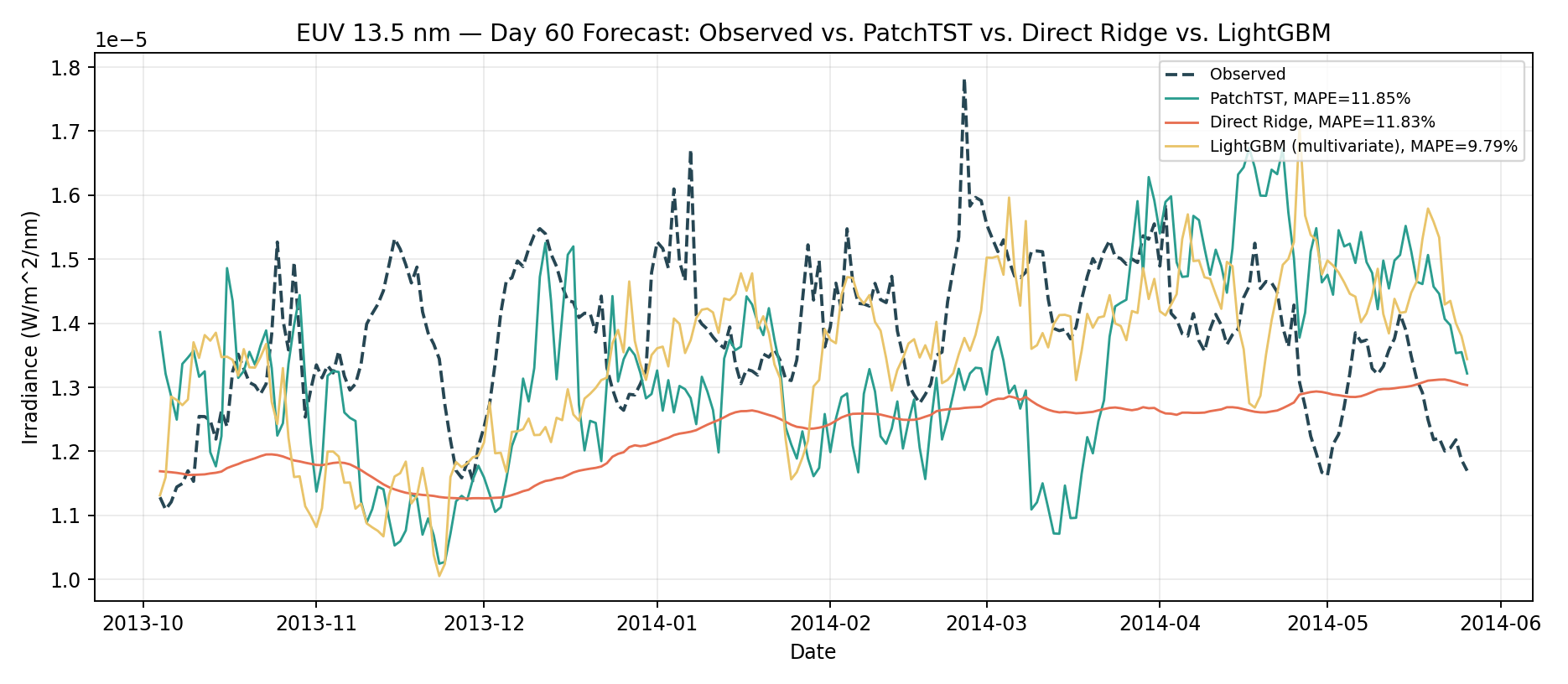
This applied research explores how a model can use the most recent 30 or 60 days of solar activity and EUV observations to estimate what the following 60 days may look like.
THE RESEARCH QUESTION
Rather than relying on a fixed, one-size-fits-all lookback, the study compares model setups that see different recent observation windows before they generate the same forward horizon.
The workflow starts with a recent sequence of observed solar behaviour, preserving the order and changing shape of the signal.
SEQUENTIAL CONTEXTEUV values are treated as a related time-varying signal, allowing the research to examine how the series move across a shared horizon.
RELATED SIGNALSThe output is a 60-day estimated sequence, not a promise of a single exact future value on one selected day.
FORWARD OUTLOOKWHAT THE MODEL IS ASKED TO LEARN
The research evaluates forecast behaviour against separately held evaluation data. That separation matters: it helps distinguish a model that recognises a pattern from one that only remembers its training examples.
The work covers model runs, experimental analysis, error analysis and technical reporting for a time-series research effort.
Any result belongs to its specific experiment, data period and evaluation design. The academic project’s concept, direction and ownership remain with its supervising lead.
START WITH THE DECISION HORIZON